

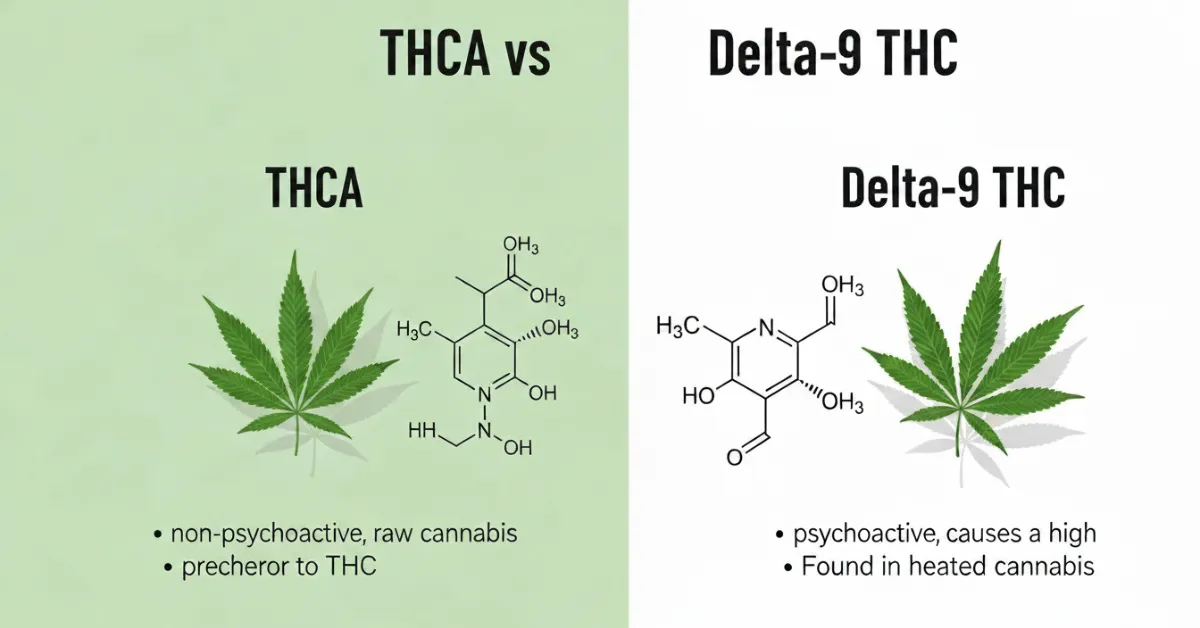
The difference between THCA and Delta 9 comes down to activation, effects, and how they interact with the body. THCA (tetrahydrocannabinolic acid) is a non-psychoactive cannabinoid in its raw form, while Delta 9 THC is the activated compound responsible for intoxicating effects.
THCA naturally exists in raw plant material and only becomes Delta 9 when exposed to heat through a process called decarboxylation. This single chemical change significantly alters how the compound behaves, its potency, and the overall user experience. This distinction is important for wellness-focused users, beginners, and experienced consumers who want to control whether they experience psychoactive effects or not.
What Is THCA?
THCA is the precursor cannabinoid found in fresh plant material. It exists in high concentrations before any heating or processing occurs. In its natural state, THCA:
- Does not produce a high
- Has limited binding to CB1 receptors
- Remains stable until exposed to heat
- Is commonly found in raw flower and cold-processed products
Because it is non-intoxicating, THCA is often chosen by users who want clear-headed support without impairment. Many users prefer formats like THCA flower products for flexibility, as they can decide whether to keep it raw or activate it depending on usage.
What Is Delta 9 THC?
Delta 9 THC is the activated form of THCA and the primary cannabinoid responsible for psychoactive effects. Once THCA is heated, it loses a carboxyl group and converts into delta-9, allowing it to:
- Bind effectively to CB1 receptors
- Produce euphoria and altered perception
- Deliver noticeable physical and mental effects
Delta 9 is widely used in both recreational and therapeutic contexts, particularly for pain relief, appetite stimulation, and mood changes.
THCA vs Delta 9: Key Differences
Understanding what is the difference between THCA and Delta 9 becomes easier when comparing them side by side:
Feature | THCA | Delta 9 THC |
Chemical Form | Acidic precursor | Activated cannabinoid |
Psychoactive | No (raw form) | Yes |
Activation | Requires heat | Already active |
Effects | Clear-headed, non-intoxicating | Euphoria, relaxation |
Receptor Binding | Weak interaction | Strong CB1 binding |
Common Use | Raw consumption, wellness | Smoking, vaping, edibles |
How THCA Converts Into Delta 9
The transformation from THCA to Delta 9 happens through decarboxylation, a heat-driven reaction.
Key facts about conversion:
- Occurs at 110–130°C (230–250°F)
- Releases carbon dioxide (CO₂)
- Changes molecular structure
- Increases psychoactive potential
Conversion efficiency:
THCA does not convert 1:1 into Delta 9. Instead, it follows a standard ratio: Delta 9 THC ≈ THCA × 0.877
For example:
- 20% THCA ≈ 17.5% Delta 9 THC after heating
This calculation is critical when evaluating potency and understanding product labels.
Effects: THCA vs Delta 9 Experience
THCA Effects (Raw Form)
- No intoxicating effects
- Maintains mental clarity
- May support daily functionality
- Suitable for daytime use
Delta 9 Effects
- Euphoria and mood elevation
- Altered sensory perception
- Relaxation or sedation
- Duration varies by method (2–8 hours)
The difference in experience is one of the most important factors when choosing between the two.
Consumption Methods and Their Impact
Your method of consumption determines whether THCA stays inactive or converts into Delta 9.
Methods That Activate Delta 9
- Smoking
- Vaping
- Baking or cooking
These methods apply heat, triggering full conversion.
Methods That Preserve THCA
- Raw formulations
- Cold-processed tinctures
- Low-temperature applications
Consumers who want flexibility often explore options like premium cannabinoid products, which provide detailed cannabinoid profiles and controlled usage.
Potency and Label Understanding
Modern product labels typically show:
- THCA percentage
- Delta-9 percentage
- Total THC value
Total THC Formula:
Total THC = (THCA × 0.877) + delta-9 THC
Example:
- 18% THCA + 1% Delta 9
- Total THC ≈ 16.8%
This helps users estimate true potency after heating, which is essential when comparing products.
Legality Differences
Legality is another major factor when understanding what is the difference between THCA and Delta 9.
THCA
- Often classified differently because it is non-intoxicating in raw form
- Commonly sold under hemp regulations
- Legal status may depend on total THC potential
Delta 9
- More strictly regulated
- Subject to specific limits (commonly 0.3% by dry weight in hemp-derived products)
- Availability varies by region
Because THCA can convert into Delta 9, regulations may consider potential THC content, not just current levels.
Therapeutic Potential Comparison
Both cannabinoids offer different types of benefits based on their state.
THCA Potential Benefits
- Anti-inflammatory support
- Neuroprotective properties
- Nausea reduction
- General wellness support
Delta 9 Benefits
- Pain relief
- Appetite stimulation
- Stress and mood management
- Muscle relaxation
While Delta 9 is more researched, THCA is gaining attention due to its non-intoxicating profile.
Side Effects and Safety
THCA (Raw)
- Minimal reported side effects
- Generally well tolerated
Delta 9
- Dry mouth
- Drowsiness
- Increased heart rate
- Possible anxiety at higher doses
Since THCA converts into Delta 9 when heated, side effects may overlap depending on the usage method.
Which One Should You Choose?
The right choice depends on your goals:
Choose THCA if you want:
- No intoxicating effects
- Daytime functionality
- Wellness-focused use
Choose Delta 9 if you want the following:
- Immediate psychoactive effects
- Stronger sensory experience
- Recreational or targeted relief
Some users combine both approaches, depending on timing and purpose. Complementary options like gummies are also used to balance overall effects.
Final Overview
Understanding what is the difference between THCA and Delta 9 is essential for choosing the right cannabinoid experience. THCA remains non-intoxicating in its raw form, while Delta 9 delivers immediate psychoactive effects after activation.
The key difference lies in heat, chemistry, and user intent, making both cannabinoids suitable for different needs. By checking product labels, understanding total THC, and selecting the right format, users can make informed decisions that align with their preferences and lifestyle.
Does THCA get you high?
No, THCA does not produce a high in its raw form because it does not effectively bind to CB1 receptors in the brain. However, once it is exposed to heat through smoking, vaping, or cooking, it converts into Delta 9 THC, which does produce psychoactive effects.
Does THCA turn into Delta 9 when smoked?
Yes, smoking or vaping THCA triggers decarboxylation, which converts it into Delta 9 THC. This means that using THCA in heated forms will result in effects very similar to traditional Delta 9 products.
Is THCA stronger than Delta 9?
THCA itself is not stronger because it is non-intoxicating in its raw state. However, when converted into Delta 9, its potency depends on the original THCA percentage, which can result in strong effects after activation.
How do I calculate total THC?
Total THC is calculated using the formula (THCA × 0.877) + Delta 9 THC. This accounts for the molecular weight loss during conversion and helps estimate the actual psychoactive potential of a product.
Will THCA show up on a drug test?
Yes, it can. Drug tests typically detect THC metabolites, which may appear if THCA is converted into Delta 9 inside the body or through heat before consumption.
Are THCA products legal?
THCA products are often sold under hemp regulations if Delta 9 THC levels remain within legal limits. However, legality can vary depending on how total THC is interpreted in specific regions.
Shop VAYU - Lab-Tested, Hemp-Derived, 21+
Every VAYU product is third-party lab-tested with a published Certificate of Analysis. Explore THCA flower, concentrates, vapes, gummies and pre-rolls.

