

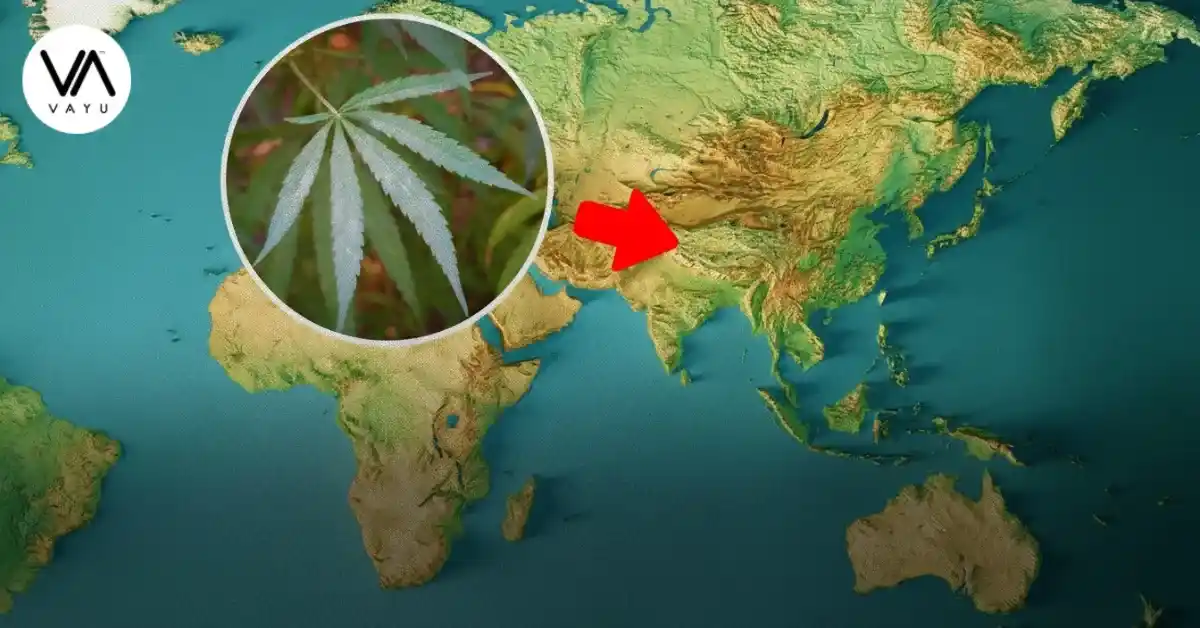
Weed originated in Central Asia, where early forms of the plant evolved millions of years ago and were later cultivated by humans between 5,000 to 10,000 years ago. From there, it spread across continents through migration, trade routes, and agricultural expansion. Today, its global presence is the result of centuries of adaptation, cultural use, and selective cultivation.
This history matters for modern consumers, especially those exploring premium products, because the plant’s journey directly shaped the potency, terpene profiles, and diversity seen in today’s market.
Early Origins in Central Asia
Natural Evolution and First Growth Regions
Scientific evidence places the origin of weed in the eastern Tibetan Plateau and surrounding Central Asian regions, including present-day China, Mongolia, and parts of South Asia. Fossil data suggests the plant evolved as early as 28 million years ago, while archaeological findings confirm human interaction thousands of years later. These regions provided ideal conditions:
- Temperate climates
- Nutrient-rich soils
- Seasonal variation supporting plant resilience
Early Human Cultivation
Humans began cultivating the plant during the early agricultural period, roughly 10,000–12,000 years ago. Initially, it was valued for practical uses:
- Fiber for rope and textiles
- Seeds as a food source
- Early medicinal applications
This makes weed one of the oldest cultivated crops in human history, alongside grains and legumes.
Ancient Civilizations and Early Uses
China: The First Documented Uses
China provides some of the earliest written records. Around 2700 BCE, traditional medical texts linked to Emperor Shen Nung documented the plant’s use for:
- Pain relief
- Inflammation control
- Digestive issues
Archaeological discoveries, including burial sites dated around 1500 BCE, show evidence of cannabinoid residues used in ceremonial practices.
India: Cultural and Medicinal Integration
In ancient India, the plant became deeply integrated into spiritual and medicinal systems. Texts like the Atharva Veda (around 800 BCE) describe it as one of the sacred plants used for:
- Stress relief
- Ritual ceremonies
- Holistic healing practices
Preparations such as infused drinks and herbal mixtures were commonly used, reflecting both cultural and functional importance.
Middle East and Persia
By 2000–1400 BCE, weed had spread into the Middle East. Persian scholars later documented its medical applications, including:
- Pain management
- Anti-inflammatory treatments
- Neurological conditions
This region also contributed to early understanding of dosage effects and preparation methods.
The Role of Trade Routes in Global Spread
Silk Road Expansion
One of the most important drivers of global distribution was the Silk Road, a network of trade routes connecting Asia, the Middle East, and Europe. Through this network:
- Seeds and plant material were transported across continents
- High-resin varieties moved westward
- Cultural practices spread alongside the plant
Nomadic Tribes and Migration
Nomadic groups such as the Scythians (around 500 BCE) played a major role in spreading weed into Eastern Europe. Historical accounts describe their use in ritual settings, where heated stones released aromatic compounds. Migration patterns contributed to:
- Regional adaptation
- Genetic diversification
- Emergence of early landrace strains
Expansion into Africa and Europe
Africa: Trade-Driven Introduction
Weed reached Africa primarily through Indian and Arab trade networks. By the 1400s–1800s, it had spread across:
- East African coastal regions
- The Congo Basin
- Southern Africa
It was used for both medicinal and cultural purposes, adapting to local climates and traditions.
Europe: Industrial and Medicinal Use
In Europe, the plant became essential for industrial applications:
- Rope and sail production for naval use
- Textile manufacturing
- Early paper production
By 500 BCE, hemp fibres were already present in European burial sites. Later, during the 19th century, medical interest increased significantly. Physicians conducted over 100 studies, leading to widespread use in pharmaceutical preparations.
Arrival in the Americas
Weed entered the Americas through multiple pathways:
Region | Time Period | Method of Introduction |
South America | 1500s–1600s | Colonial trade & migration |
North America | Early 1600s | Agricultural mandates |
Caribbean | 1800s | Labor migration & trade |
In 1619, cultivation was encouraged in parts of North America due to its industrial value. It was widely used for:
- Rope and sails
- Clothing materials
- Agricultural production
Cultural Influence
By the early 20th century, recreational use became more visible, influenced by migration patterns and cultural exchange. This marked a shift from purely industrial and medicinal applications to broader social use.
Development of Landrace Strains
As the plant spread globally, it adapted to different climates, creating landrace strains, genetically distinct varieties native to specific regions. Examples include:
- Mountain-region strains with dense structures
- Tropical varieties with taller growth patterns
- Cold-climate types with faster flowering cycles
Importance in Modern Products
These landraces form the genetic foundation of today’s premium products. Modern cultivation, including indoor THCA flower, builds on these genetics to enhance:
- Potency
- Terpene profiles
- Visual quality
This is why curated collections like premium indoor THCA flower reflect centuries of natural and selective evolution.
Modern Era and Scientific Understanding
19th and 20th Century Developments
During the 1800s, weed gained attention in Western medicine, with documented use for:
- Pain relief
- Muscle spasms
- Neurological conditions
However, by the early 20th century, regulations increased globally, shifting public perception and limiting access in many regions.
21st Century Shift
In recent years, interest has shifted toward cannabinoids and their potential applications. Advances in cultivation and extraction have led to:
- High-THCA flower with improved purity
- Controlled indoor growing environments
- Lab-tested cannabinoid profiles
This evolution reflects a return to quality-focused cultivation, similar in intent to early uses but supported by modern science.
Why This History Matters Today
Understanding the origins of weed provides context for modern products and quality standards. The plant’s journey explains:
- Why different strains have unique effects
- How terpene diversity developed
- Why indoor cultivation enhances consistency
For consumers browsing THCA products or other categories, this background helps connect historical cultivation to modern refinement.
Final Thoughts
The origins of weed reflect a long history of human interaction, adaptation, and innovation. From its roots in Central Asia to its global presence today, the plant has evolved alongside civilisations, shaping and being shaped by culture, trade, and science.
Modern advancements in cultivation, including high-quality indoor THCA flower, are built on this foundation, combining ancient genetics with precise techniques to deliver consistent and refined products.
Where did weed originally come from?
Weed originated in Central Asia, particularly around the Tibetan Plateau and nearby regions, where it naturally evolved before being cultivated by humans thousands of years ago.
How did weed spread across the world?
It spread through trade routes like the Silk Road, migration of nomadic tribes, and agricultural expansion, eventually reaching Europe, Africa, and the Americas.
When did humans start using weed?
Human use dates back at least 10,000 years, initially for fibre and food, followed by medicinal and cultural applications in ancient civilizations.
What are landrace strains?
Landrace strains are naturally developed varieties that adapted to specific regions over time, forming the genetic base for modern cultivated strains.
Why was weed important historically?
It was valued for multiple purposes, including textiles, medicine, food, and cultural practices, making it one of the most versatile early crops.
How does its history affect modern THCA products?
Modern THCA flower is developed from historical genetics and improved through controlled cultivation, resulting in higher potency, better terpene retention, and consistent quality.
Shop VAYU - Lab-Tested, Hemp-Derived, 21+
Every VAYU product is third-party lab-tested with a published Certificate of Analysis. Explore THCA flower, concentrates, vapes, gummies and pre-rolls.

