

Vape laws in the United States changed fast heading into 2026, and most of the change has landed on two things specifically: flavored vapes and disposable vapes. There is still no single federal law banning all vaping, but a growing number of states now restrict which products can be sold – through outright flavor bans, state-run “approved product” directories, or limits aimed at single-use disposables. If you have searched for which states are banning vapes, what states still allow flavored vapes, or whether vapes are getting banned in 2026, this guide lays out where things actually stand and, just as important, what these rules do and do not cover.
One distinction matters before we go state by state, because nearly every headline blurs it: almost all of these laws were written for nicotine e-cigarettes, not for hemp-derived THC products. We cover that difference in plain English below so you can tell which rules apply to what. Everything VAYU sells is hemp-derived, third-party lab-tested, and intended for adults 21 and over.
Are Vapes Getting Banned in 2026? The Short Answer
No – vaping is not illegal nationwide in 2026, and there is no federal law banning all vapes. What is happening is narrower and more state-by-state: many states have made most flavored and disposable nicotine vapes illegal to sell, even when those products were legally manufactured. For a shopper, losing your favorite flavor or device can feel like a ban, even though “vaping” as a whole is still legal where you live.
Are vapes illegal, then? Not as a category. But the list of products you can legally buy – especially flavored disposables – is shrinking in a lot of states. The rest of this guide breaks down exactly how, and where.
Nicotine Flavored-Vape Bans vs. Hemp-Derived THC Vapes (Read This First)
Here is the part most coverage skips. Nearly every state vape ban and registry on this page was written for nicotine products. The statutes talk about e-liquids, nicotine strength, and tobacco retail licensing, and the state “approved product” directories are lists of approved nicotine products. Several of the newer registry laws are even keyed to the FDA’s premarket tobacco application process – paperwork that exists for nicotine and tobacco products, not for hemp.
Hemp-derived THC vapes usually sit under a different rulebook: your state’s hemp law, built on the 2018 Farm Bill framework, which defines hemp as cannabis containing no more than 0.3% total Delta-9 THC on a dry-weight basis. In most states these products are overseen through a hemp program or the agriculture department – separate from tobacco and nicotine rules.
The line is not identical everywhere, though. A handful of states apply their vape rules to all vaping hardware no matter what is inside, and some restrict inhalable hemp products specifically under their hemp laws. So the honest takeaway is this: a state appearing on a nicotine ban or registry list does not automatically mean hemp disposables are restricted there – and a state missing from the list does not automatically mean they are allowed. Your state’s hemp rules are what actually control. We will show you how to check yours near the end.
The Three Ways States Are Restricting Vapes in 2026
Laws vary, but almost every state action falls into one of three buckets. Knowing the model explains why the same product is legal in one state and banned in the next.
1. Flavor Bans
Some states prohibit any vape flavored as anything other than tobacco. These bans usually include menthol and apply to both in-store and online sales, which removes fruit, candy, dessert, and mint vapes from legal shelves entirely. This is the model behind most “what states are banning flavored vapes” searches.
2. Product Directory / Registry Systems (PMTA Registries)
The fastest-growing model. Under a state directory law, only nicotine vapes listed on an official state registry can be sold, and manufacturers have to certify each product – usually by showing it is FDA-authorized or has a pending federal application. In practice this removes the vast majority of disposable vapes from a state’s market, because most disposable brands do not qualify. Importantly, a product can have full FDA authorization and still be blocked in a registry state until the maker completes that state’s separate certification.
3. Disposable-Specific Limits
Some states zero in on disposable vapes – blamed for waste, youth appeal, and lack of oversight – without banning refillable hardware. Texas pioneered the model: rather than banning by flavor, it targets disposables by country of manufacture, restricting Chinese-made disposables while leaving many refillable systems and non-Chinese products available. Indiana followed with its own “foreign adversary” manufacturing ban effective July 1, 2026, and Hawaii went furthest – a categorical ban on disposable sales starting January 1, 2027.
What Changed in July and August 2026 (Latest Updates)
A second wave of state laws landed on July 1, 2026, and the courts were busy too. The quick rundown, current as of August 17, 2026:
- Virginia – the Vape Enforcement Act took effect July 1, moving enforcement to the state ABC authority. Retailers now need an ABC permit to sell liquid nicotine, with underage-sale fines up to $2,500 and license revocation possible on a third offense.
- West Virginia – the vape tax changed from a flat 7.5 cents per milliliter to 50% of the wholesale price, and monthly non-compliance penalties jumped from $25 to $500.
- Utah – the e-cigarette tax rose from 56% to 71% of the manufacturer’s price on July 1.
- Indiana – a new law effective July 1 bans vapes manufactured in “foreign adversary” nations – in practice, most Chinese-made hardware. Indiana now restricts disposables by origin the way Texas does, on top of its directory law.
- North Carolina – the state budget added a $1,000 annual tax on vape shops and mandatory 21+ age verification at checkout.
- Hawaii – a law signed July 7 will ban disposable vape sales entirely starting January 1, 2027 (FDA-authorized products exempt). Hawaii becomes the first state with a categorical disposable ban on the calendar.
- Pennsylvania – the Attorney General updated the state’s certification list in late June; vapes not on it face enforcement starting October 19, 2026.
- In the courts – Alabama’s Supreme Court upheld the state’s vape directory law on July 7, and a Denver court upheld the city’s flavored-tobacco ban. The legal trend so far in 2026: registries and local flavor bans keep surviving challenges.
On the hemp side, one big change: as of July 31, 2026, Texas treats delta-8, delta-10, THCP and other non-delta-9 THC isomers as controlled substances – a state supreme-court fight that ended this spring. THCA sits under a separate, still-contested rulebook there; our Texas THCA guide tracks it. And federally, the November 12, 2026 hemp redefinition still stands as of today, though a Senate-passed funding bill would push most of it to December 11 – not law yet.
What States Are Banning Flavored Vapes in 2026? (Flavor-Ban States)
These states have true statewide flavor bans – meaning a flavored nicotine vape is illegal to sell regardless of who made it. As of 2026 the core flavor-ban states are:
- California – flavored tobacco and vape sales banned statewide, including menthol (SB 793, upheld by voters via Prop 31; expanded by AB 3218). Only tobacco-flavored products on the state’s Unflavored Tobacco List are legal.
- Massachusetts – long-standing, comprehensive flavor ban; only tobacco-flavored options remain.
- New Jersey – bans all flavored vapes, including menthol; tobacco flavor only.
- New York – bans flavored vapes other than tobacco (no fruit or dessert flavors).
- Rhode Island – bans flavored vapes other than tobacco.
Several other states enacted flavor restrictions earlier in the decade – including Colorado, Oregon, and Washington – and many cities have their own flavor rules even where the state does not. San Francisco goes furthest of all, banning the sale of all e-cigarette/vaping products regardless of flavor.
States Using Approved-Product Directories in 2026 (14 States)
Directory/registry states do not necessarily ban flavors outright, but they sharply limit which nicotine vapes can be sold – which removes most disposables in practice. As of mid-2026, 14 states have active or imminent PMTA product registries:
- North Carolina – directory active May 1, 2026
- Virginia – directory published Jan 1, 2026; enforcement underway (full registry framework effective July 1, 2026)
- Wisconsin – effective July 1, 2026
- Mississippi
- Utah (enacted; portions on hold pending litigation)
- Indiana
- Louisiana
- Arkansas
- Georgia
- Tennessee
- South Carolina
- Alabama
- Kentucky
- West Virginia
Some of these laws are being challenged in court, so the exact status can shift – Utah’s is partly on hold pending a lawsuit, for example, while others have been upheld. The trend, though, is clearly toward more directory states, not fewer.
Comparison: How the Major States Restrict Vapes in 2026
| State | Restriction type | What it means for shoppers |
|---|---|---|
| California | Flavor ban + Unflavored Tobacco List | Most flavored nicotine vapes unavailable; tobacco-flavor only |
| Massachusetts | Full flavor ban | Only tobacco-flavored options allowed |
| New York | Flavor ban (non-tobacco) | No fruit, mint, or dessert flavors |
| New Jersey | Full flavor ban (incl. menthol) | Tobacco flavor only |
| Rhode Island | Flavor ban (non-tobacco) | Tobacco flavor only |
| Virginia | State approval directory | Retailers must pull any unlisted vape |
| North Carolina | Product directory (active May 2026) | Many disposables removed |
| Wisconsin | Product directory (July 2026) | Very limited legal options |
| Florida | Disposable/NDD directory | Many disposables removed; open-system devices remain |
| Texas | Disposable origin limits | Chinese-made disposables restricted; refillables less affected |
The models differ, but the outcome rhymes: fewer legal vape options, and flavored disposables hit hardest.
What States Still Allow Flavored Vapes in 2026?
Plenty of states have no statewide flavor ban and no product directory – they rely on federal law plus the standard 21+ age requirement. Much of the South and Midwest falls here, with states like Texas (nicotine flavors allowed; it restricts disposables by origin instead – though note its hemp-THC rules changed sharply on July 31, 2026), Arizona, Wyoming, and Montana among those with relatively light restrictions. Florida has no statewide flavor ban either, though it limits certain disposables through its Nicotine Dispensing Device directory.
Two caveats keep this honest. First, “no statewide flavor ban” does not mean “no rules” – cities and counties frequently pass their own flavor restrictions, so local law can differ from state law. Second, several states on the “no flavor ban” side now run directory systems that quietly remove most disposables anyway. The practical answer to “what states still sell flavored vapes” is: many do, but the list shrinks every legislative session, and it depends on your specific city as much as your state.
Which Vape Products Are FDA-Authorized for Legal Sale in 2026?
This is a common point of confusion, so here is the precise status. As of May 5, 2026, the FDA has authorized 45 ENDS (electronic nicotine delivery system) products through the premarket tobacco application (PMTA) pathway. Per the FDA, those 45 products are the only e-cigarette/vape products that may currently be lawfully sold in the U.S. The authorized products come from a small group of brands – including Vuse, NJOY, Logic, JUUL, and Glas – and the current list is published by the FDA at fda.gov/authorizedecigs.
Two 2026 details worth knowing:
- The first non-tobacco/non-menthol vape was authorized. In May 2026 the FDA authorized four Glas pods – including non-tobacco, non-menthol flavors – the agency’s first such authorization, granted because the device uses ID-based, Bluetooth-paired age-gating technology intended to keep youth from using it.
- No disposable vape brand has FDA authorization. Every popular disposable brand (Elf Bar, Geek Bar, Vozol, and the rest) is on the market without FDA marketing authorization – which is exactly why state directory laws sweep so many of them off shelves.
One more time, because it matters: this FDA list is a nicotine/tobacco list. Hemp-derived THC vapes are not “FDA-authorized e-cigarettes” and are not meant to be – they fall under hemp law, not the tobacco PMTA process.
What These Bans Mean for You as a Shopper
If you buy flavored or disposable nicotine vapes, expect favorite products to disappear in flavor-ban and directory states, and expect tighter online rules: most major carriers will not ship vapes to consumers, and compliant sellers must run strict age verification and obey each state’s directory. Buying from unlicensed or grey-market sellers to get around a ban carries real risk – inconsistent quality and no safety testing.
Some people use these changes as a reason to cut back or quit. Others look for legal, lab-tested alternatives in a different category. That second group is where the hemp-vs-nicotine distinction above actually becomes useful – more on that next.
Where Lab-Tested Hemp-Derived Disposables Fit In
To be clear and not misleading: this section is about a different category of product than the nicotine vapes the bans above target. VAYU does not sell nicotine e-cigarettes. We sell hemp-derived THC products – governed by the 2018 Farm Bill and your state’s hemp law, not by tobacco/nicotine vape statutes.
If you have been researching nicotine flavor bans and want to know whether a lab-tested hemp-derived option ships to you, a few honest pointers:
- It is a separate legal framework. A nicotine flavor ban in your state does not automatically restrict hemp-derived disposables – but it does not automatically allow them either. Your state’s hemp rules decide, so check those (we show you how below).
- Insist on a COA. A compliant hemp product comes with a third-party lab report (Certificate of Analysis) showing total Delta-9 THC at or below 0.3% on a dry-weight basis. VAYU publishes batch lab results for every product we sell.
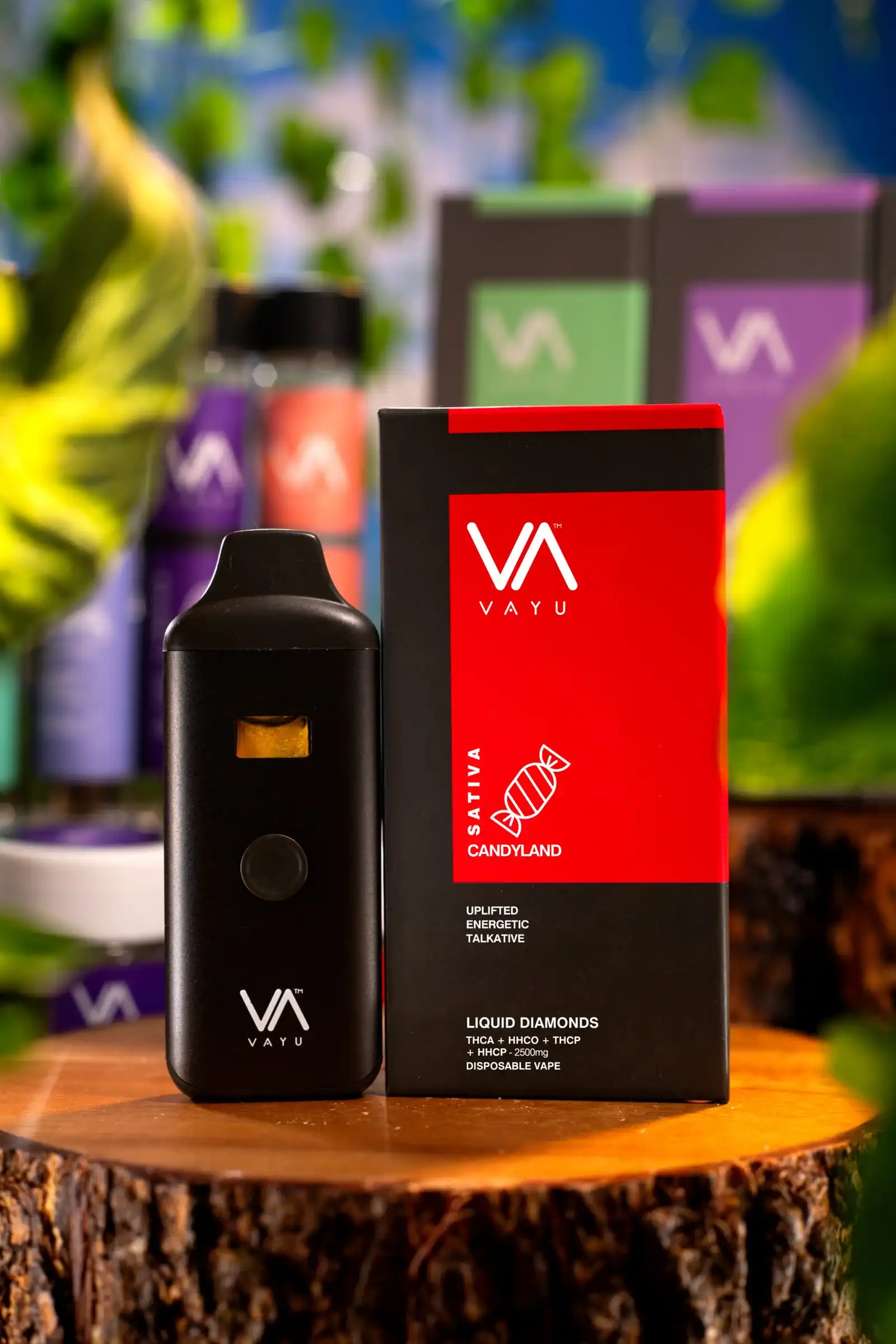
- Browse the category, not a promise. If you want to see what hemp-derived options look like, our disposable THC vapes and solventless cold-cured live rosin disposables are good places to start. Whether any given product can ship to you still depends on your state – confirm before you order.
And if disposables get harder to find where you live, solventless concentrates are another route entirely: our live resin badder and live resin diamond sauce collections are dab-ready, lab-tested formats governed by the same hemp framework – no battery, no flavor cartridge, no vape-ban exposure.
New to vaping or hemp-derived products in general? These VAYU explainers cover the basics without the hype:
- What Is Vaping and How Does It Work?
- How Does a Vape Work?
- What Is Considered a High-THC Vape?
- Can a Drug Test Detect THC Vapes?
How to Check Whether a Disposable Ships to Your State
Four quick steps cover it for most shoppers:
- Check the retailer’s shipping policy. Reputable hemp sellers publish a current list of states they ship to and states they do not. You will find ours on our shipping information page.
- Confirm the product is genuinely hemp-derived. Look for a COA from a third-party lab showing total Delta-9 THC at or below 0.3% by dry weight. We publish batch lab results for every product.
- Check your state’s own rules. Your state hemp program (usually in the agriculture department) or your state attorney general’s site spells out how inhalable hemp products are treated where you live.
- When in doubt, ask first. A quick message to the seller’s support team beats a canceled order or an undeliverable package.
What to Expect Beyond 2026
The momentum is toward more directory/registry states rather than more outright flavor bans – it lets lawmakers control the market without rewriting tobacco law from scratch. The 2026 court record so far backs that up: Alabama’s directory survived its supreme-court challenge in July, and Denver’s flavor ban was upheld the same month. Expect the pool of legal disposable nicotine vapes to keep shrinking (Hawaii’s outright disposable ban arrives January 1, 2027), expect more origin-based bans on Chinese-made hardware like Texas’s and Indiana’s, and expect local rules to keep diverging from state law. Bottom line: check your own state and city before you buy, because this landscape moves quickly.
Try VAYU – Lab-Tested, Hemp-Derived, 21+
VAYU’s products are hemp-derived (not nicotine) and third-party lab-tested, with a published Certificate of Analysis for every batch. If you want to explore legal, transparent options:
- Browse hemp-derived disposable vapes
- Explore solventless cold-cured live rosin disposables
- View every product’s third-party lab results
Want 20% off your first order? Join the VAYU newsletter and Text Club for your discount code, plus early access to drops and new strains. (Msg & data rates may apply. Reply STOP to opt out. 21+.) Whether any product can ship to you depends on your state – confirm before ordering.
Frequently Asked Questions
What states are banning flavored vapes in 2026?
The core flavor-ban states – where flavored nicotine vapes are illegal to sell regardless of manufacturer – are California, Massachusetts, New Jersey, New York, and Rhode Island, with Colorado, Oregon, and Washington having enacted flavor restrictions earlier. Many other states limit flavored disposables indirectly through approved-product directories, and some cities (like San Francisco) ban all vape sales.
What states are banning vapes in 2026?
No state bans all vaping outright (San Francisco bans all sales at the city level). Beyond the flavor-ban states above, 14 states run “approved product” directories that remove most nicotine disposables: North Carolina, Virginia, Wisconsin, Mississippi, Utah, Indiana, Louisiana, Arkansas, Georgia, Tennessee, South Carolina, Alabama, Kentucky, and West Virginia.
What states still allow flavored vapes?
Many states have no statewide flavor ban – much of the South and Midwest, including Texas (which restricts disposables by origin instead), Arizona, Wyoming, and Montana. But local city/county rules can still restrict flavors, and several “no flavor ban” states run directories that remove most disposables anyway, so always check your specific location.
Are vapes getting banned in 2026?
Not as a whole. Vaping remains legal nationwide, but the number of legally sellable products – especially flavored and disposable nicotine vapes – is shrinking through state flavor bans and approved-product directories.
Are vapes illegal?
No, vapes are not illegal as a category in the U.S. Whether a specific product is legal to sell depends on your state and city, the product’s flavor, whether it is a disposable, and (for nicotine vapes) whether it is FDA-authorized and listed on your state’s directory.
Are vapes illegal in California in 2026?
Vaping itself is legal in California, but flavored vapes are banned statewide, including menthol. Only tobacco-flavored products on the California Attorney General’s Unflavored Tobacco List can be legally sold. The law targets retailers, not consumers.
Is Virginia banning vapes in 2026?
Virginia is not banning all vapes, but it now runs an approved-product directory: nicotine vapes not listed on the state directory cannot be sold. Since July 1, 2026, enforcement sits with the Virginia ABC authority – retailers need an ABC permit to sell liquid nicotine, with fines up to $2,500 for underage sales. It functions as a ban on most disposables rather than a flavor ban.
Is Hawaii banning disposable vapes?
Yes – a law signed July 7, 2026 bans the sale and distribution of disposable vapes in Hawaii starting January 1, 2027. FDA-authorized products are exempt, but since no disposable brand currently holds FDA authorization, the practical effect is a full disposable ban.
Is Indiana banning vapes in 2026?
Indiana is not banning all vapes, but two rules stack there: a PMTA-style directory law, plus a ban effective July 1, 2026 on vapes manufactured in “foreign adversary” countries – which covers most Chinese-made hardware. Retailers have warned of shortages as a result.
Which vape products are FDA-authorized for legal sale in 2026?
As of May 5, 2026, the FDA has authorized 45 ENDS products through the PMTA pathway, and per the FDA those are the only e-cigarette products that may be lawfully sold in the U.S. They come from a few brands (Vuse, NJOY, Logic, JUUL, Glas). No disposable vape brand has FDA authorization. The current list is published at fda.gov/authorizedecigs. Note this is a nicotine/tobacco list – hemp-derived THC vapes fall under hemp law, not the tobacco PMTA process.
Are disposable vapes banned everywhere?
No, but disposables are the main target of 2026 rules. Flavor bans and directory laws remove most disposables in those states, and no disposable brand is FDA-authorized, so availability is shrinking even where they are not explicitly banned.
Can I still buy vapes online in 2026?
Yes, but it is heavily restricted. Most major carriers will not deliver vapes to consumers, and compliant sellers must use strict age verification and obey each state’s directory and shipping rules, so availability depends on your location.
Do nicotine vape bans apply to hemp-derived THC vapes?
Usually they are separate frameworks: nicotine bans and registries target nicotine products, while hemp-derived products fall under your state’s hemp law. But a handful of states restrict all inhalable hemp, or all vape hardware regardless of contents, so the only reliable answer is to check your own state’s hemp rules – or simply check the retailer’s shipping list – before you buy.
Can I order a hemp-derived THC vape if my state banned flavored nicotine vapes?
Often, yes – flavored-vape bans typically target nicotine products, and hemp-derived items are governed by your state’s hemp law instead. “Often” is not “always,” though, so verify your state’s hemp rules or check the retailer’s shipping list first. These products are for adults 21 and over.
How do I know a disposable is hemp-derived and compliant?
Ask for the COA. A compliant hemp product comes with a third-party lab report showing total Delta-9 THC at or below 0.3% on a dry-weight basis, and reputable sellers post one for every batch. If a seller cannot show a current COA, shop somewhere else. And as always, these products are for adults 21 and over.
Related: Looking for hemp THC rather than nicotine vapes? Most of the laws above apply to nicotine products — for where hemp THCA stands, see our Is THCA Legal? THCA Laws by State guide, including our Is THCA Legal in Texas? breakdown.

